









)
Building The Largest iPhone: An Electronics Hack at Extreme Scale.
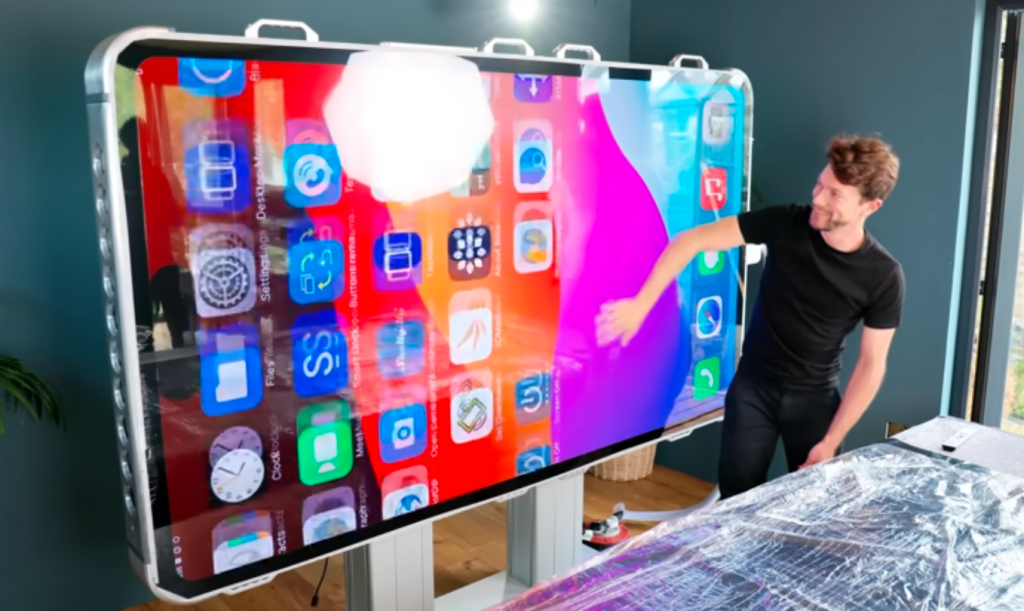
Electronics hacks often focus on miniaturisation, yet building the Largest iPhone flips that idea completely. This ambitious project documents how a small, agile team set out to recreate a fully functional iPhone at a massive scale. Rather than producing a simple visual replica, every component must work as intended. As a result, the challenge becomes a real-world test of electronics design, materials science, and creative problem-solving.
Building the Largest iPhone: Planning a Giant Electronics Project from the Start:
Large-scale electronics demand careful planning before any component is assembled. Therefore, the team mapped each subsystem in advance, from display technology to input controls and audio output. By treating the project like a professional hardware build, mistakes became learning opportunities instead of failures. This mindset remains central to successfully building the largest iPhone.
Choosing the Display: OLED Quality Versus Touch Accuracy.
Display quality defines the visual impact of a giant device. For this reason, an 88-inch OLED television was selected to replicate iPhone-level colour accuracy and contrast. OLED panels deliver deep blacks and vibrant tones even at large sizes. However, touch input introduced unexpected complications. At this scale, capacitive touch layers interfere with OLED glass and internal arrays. Consequently, touch detection became unstable and unreliable.
The Touch Challenge and a Custom Electronics Hack
Rather than sacrificing image quality, the team explored a custom workaround. A separate, standalone touch layer was designed and manufactured specifically for the oversized display. This approach preserves OLED clarity while isolating touch-sensing hardware. However, interference from thick glass and signal cross-talk still complicates installation. As Building The largest iPhone continues, repeated testing and alternative sensor designs remain essential.
Iteration, Testing, and Real Engineering Lessons
Electronics hacks succeed through iteration, not perfection. Throughout the build, failed adhesives, alignment errors, and signal noise appeared frequently. Instead of hiding these issues, the team documented each step openly. This transparency demonstrates how real electronics engineering works: through measurement, adjustment, and repeated refinement. As a result, viewers gain practical insight into large-format device design.
Exploring Alternative Touch Technologies
When traditional capacitive methods struggle, engineers adapt. Therefore, several fallback options remain under consideration. Infrared touch grids, pressure-based sensors, and hybrid stylus systems offer potential alternatives. Each option carries trade-offs in cost, responsiveness, and complexity. Exploring these paths keeps Building The largest iPhone grounded in real electronics problem-solving rather than spectacle alone.
Mechanical Stability and Structural Design.
Beyond electronics, physical construction plays a major role. Mounting systems must distribute weight evenly while protecting fragile components. Additionally, vibration control and frame rigidity prevent long-term damage. These mechanical refinements ensure the oversized device remains functional during demonstrations and testing.
Why This Electronics Hack Matters
Building the largest iPhone (DIY) proves electronics hacks scale beyond hobby projects. It highlights how planning, experimentation, and collaboration transform bold ideas into working systems. More importantly, it inspires creators to push boundaries while respecting engineering fundamentals.
Building The Largest iPhone: Final Thoughts
Building the largest iPhone blends creativity with disciplined electronics design. By documenting challenges honestly and exploring multiple solutions, this project delivers real educational value. Whether you follow for inspiration or technical insight, this Electronics Hack shows how big ideas come to life through persistence, testing, and smart engineering.
Comments